

Unlevel slabs and the settling of a building can be a big risk to the safety of a home and can lower property value. Polyurethane foam injection can fix this. It works by putting high-density expanding foam into empty spaces under the ground. The foam goes in through small holes they drill. When the foam grows, it pushes weak soil tighter and gets the structure back in place in just a few minutes. This way, you get a fix for your Foundation Repair needs that lasts a long time, and you don’t need to dig up anything.
Traditional mudjacking uses a thick cement mix. This mix adds more weight to soil that is already weak. Instead, people now make use of these special lightweight materials. Because they use this material, you will not be adding weight to the floor. Homeowners use this to stop extra sinking, which can happen when you put too much above soft soil.
What Causes Concrete Slabs to Settle?
The movement of soil is the primary cause of the majority of structural problems encountered with concrete. According to the US Geological Survey, expansive clays that swell when wet are responsible for a large amount of structural damage to buildings annually in North America. Clay expands when wet and contracts when dry, forming voids beneath the load-bearing structure of houses.
Bad water flow, soil washing away, and not getting the site ready in the right way can make open spaces under the ground form faster. Technicians from Level Tech Lifting often see that loose fill dirt will sink down in about 3 to 5 years after construction work. This will leave the concrete parts above with nothing under them, so they may crack or break.
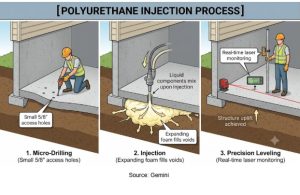
Polyurethane Concrete Injection Process
The polyurethane slab lifting process entails the mixing of two types of chemicals, which are referred to as isocyanate and polyol. The two substances are mixed together under pressure, and once they come into contact with each other, the reaction results in the formation of a water-resistant and expansive foam.
- Micro-Drilling: The technicians drill 5/8-inch holes through the slab to get underneath it.
- Polymer Injection: A high-pressure machine injects liquid polyurethane underneath the slab.
- Foam Expansion and Structure Uplift: The foam expands to fill the empty areas under the structure. Laser levels keep track the whole time.
- Hole Patching: Workers seal the holes with grout that matches the color, so the entry points are hard to see.
The stuff gets 90% of its top compressive strength in just 15 minutes. So, it can be used almost right away.
| Property | Polyurethane Injection | Traditional Mudjacking |
| Material Weight | 2–4 lbs per cu. ft. | 100–120 lbs per cu. ft. |
| Hole Size | 5/8 inch | 1.5 to 2 inches |
| Cure Time | 15–30 minutes | 24–48 hours |
| Moisture Resistance | Hydrophobic (Impermeable) | Hydrophilic (Eroded by water) |
Key Advantages Over Mudjacking
The weight of the material used is the major technical parameter that makes these two techniques different. Putting the heavy mudjacking mixture over weak and wet soil can result in additional sinking of the ground under the slabs. The light nature of structural poly-jacking does not cause any additional strain on the ground. It also provides higher compressive strength.
- Soil Compaction: In order to compact the soil, strong pressure is exerted before the lifting procedure.
- Water Resistance: Hydrophobic composition repels water and will not wash off even during heavy rains.
- Erosion Control: After drying, the foam acts as an obstruction to the water flow.
- Minimal Footprint: The light tools for injection do not hurt your grass like big trucks do.
Research from the Federal Highway Administration (FHWA) shows that polyurethane injection is a good way to keep the base under roads strong for a long time. This technique is very long-lasting, and the area can be reused quickly once the process is complete.
Cost Analysis and ROI
Polyurethane injection normally costs from $1,200 up to $4,500. Cost depends on the size of the gap as well as the area size. If one excavates and replaces the entire foundation, the cost would be higher, going from $15,000 to $30,000 or even more. Such work is highly disruptive.
| Solution Type | Estimated Cost | Core Benefits & Impact | Project Duration |
| Polyurethane Lifting | $1,200 – $4,500 | Preserves original slab, zero structural soil overburden, minimal property disruption | 1 Day |
| Excavation & Re-pour | $15,000 – $30,000+ | High property disruption, heavy machinery footprint, complete replacement required | ~2 Weeks Downtime |
According to the National Association of Realtors (NAR), having structural issues in a house reduces its resale value by 10% to 15%. By using early foundation repair in the form of polyurethane injection, you ensure that your home’s value is preserved and additional damage to the house is prevented. Level Tech Lifting provides site evaluations to discover soil issues earlier, to prevent expensive repairs of your house later.
FAQ
Is polyurethane injection safe for the groundwater?
Yes, the high-density polyurethane, when cured, is inert to other substances. It is non-hazardous and safe to use, not causing any danger to humans and other living creatures as well as the environment. No negative substances can penetrate the soil or the neighboring water with its help.
For how long will the repair by using polyurethane foam last?
Since polyurethane is non-degradable in soil and is not hygroscopic, it will last as long as the concrete foundation itself.
When can I start driving on the fixed slab?
Slabs treated by Level Tech Lifting can be used by people right away. They can also handle cars and other vehicles after 30 minutes of the injection.
Can polyurethane lift deep structural foundations?
Yes, deep soil injections can be used to inject special pipes into very weak soils that are below the surface. These pipes help hold together the soft parts and lift up building supports.
Stabilize Your Investment with Level Tech Lifting
When the ground under your home is not stable, waiting to fix it can make repairs cost more later. Advanced polymer injection is a fast and simple way to fix this problem. It lasts a long time and is not as hard on your home as old methods like concrete work. If you choose Level Tech Lifting and new foundation repair, you protect your home, make it safer for people, and make sure the place keeps its value for years to come.
