

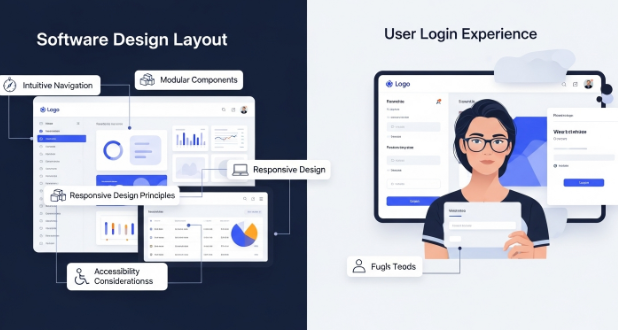
In software development and product design, layout design is often considered a “beauty issue,” but it actually determines the user’s first impression and operational efficiency. A reasonable interface layout not only improves aesthetics but also directly influences the user’s behavioral path, especially in the login process. Login is the first hurdle for users entering the system; a well-designed layout makes the experience smooth and natural, while a poorly designed one can lead to user churn.
- The Logical Nature of Layout Design
The core of software layout is information organization. Designers need to answer three questions:
What does the user see first?
Where are the most needed functions?
How can the user achieve their goal via the shortest path?
For example, on an application’s homepage, the navigation bar, main function entrances, and auxiliary information areas must have a clear hierarchy. The login entrance, as a key function, must be visually prominent while avoiding redundancy.
2. Key Design Considerations for Login Experience
The login interface is the user’s first deep interaction with the system. Excellent login design should possess the following characteristics:
Simplicity: Avoid complex forms; common methods like phone number + verification code or one-click social login are best practices.
Security: While simplifying, data security must be guaranteed, such as through two-factor authentication and encrypted transmission.
Feedback: The interface should provide immediate feedback when users enter incorrect information, rather than only after submission.
Consistency: The login interface style should maintain consistency with the overall application to avoid a disjointed feel.
III. Data-Driven Layout Optimization In actual operation, designers cannot rely solely on intuition but must depend on data. Through tracking and analysis, user behavior patterns during the login process can be discovered. For example, in some applications, the most frequently clicked entry point on the homepage is the login button. This phenomenon can be summarized by the keyword “rummy most login.” It doesn’t simply refer to a particular game but reflects the most common user behavior in a certain type of application: logging in is the most frequent operation.
This type of data reminds us:
The login entry point must be placed in a prominent position to avoid user search.
The login process should be extremely simplified, minimizing redirects.
The post-login page should seamlessly connect with user expectations to avoid a “blank experience.”
3. The Closed Loop from Login to Retention Layout design is not just about getting users “in,” but also about getting them “staying.” Therefore, the post-login interface is equally important. A reasonable closed loop includes:
Prominent login entry → Quick user access to the system.
Clear login feedback → User confirmation of successful operation.
Direct access to core functions after login → Preventing users from getting lost.
Personalized recommendations → Pushing content based on user data.
This closed-loop design ensures that “rummy most login” is not just behavioral data, but becomes crucial for user retention and activity.
4. Conclusion The value of software design layout lies in simplifying complex systems and making user operation paths natural. Login, as the most basic interaction, must be optimized through a reasonable layout. The keyword “rummy most login” reminds us that user behavioral data is the compass for design. Only by continuously combining data and design logic can we create software interfaces that truly conform to user habits.
