

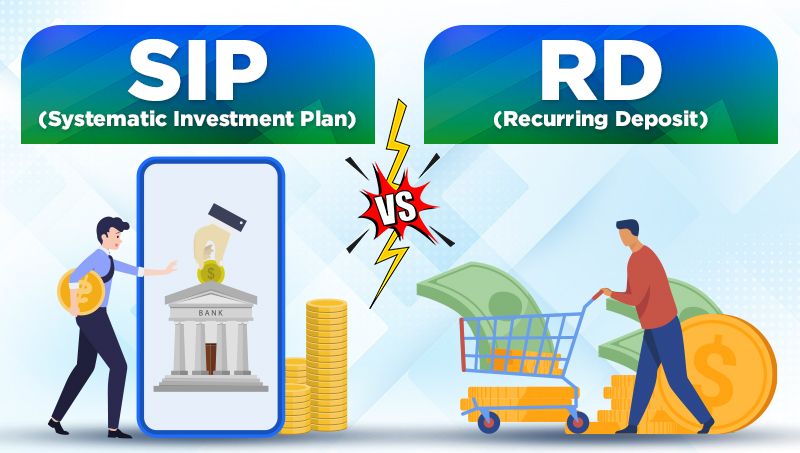
Planning your investments can feel confusing when you are trying to balance safety, returns, and long-term goals. Two of the most popular monthly investment options for Indians are Recurring Deposits and Systematic Investment Plans. Both allow you to invest a fixed amount every month, but they work very differently and serve different financial needs.
If you have ever wondered whether an RD or SIP is better for you, this guide will help you understand each option and decide which one fits your goals.
What Is a Recurring Deposit (RD)?
A Recurring Deposit is a fixed income instrument offered by banks and post offices. It allows you to deposit a fixed amount every month for a selected period. The bank pays a fixed interest rate throughout the tenure, which means you know exactly what you will receive at maturity.
RDs are simple, predictable, and suitable for people who want stable returns without exposure to market risk. They are commonly used to build short term savings and encourage a disciplined habit of monthly investing.
Key things to know about RDs
- They offer fixed and assured returns that do not change during the tenure.
- They help you save consistently because you need to deposit the same amount every month.
- They are considered low risk because they are backed by banks and covered under deposit insurance up to permitted limits.
- They are ideal for short to medium term goals where safety is more important than high returns.
What is a Systematic Investment Plan (SIP)?
A Systematic Investment Plan is a method investing in mutual funds. Instead of investing a large amount at once, you contribute a fixed amount every month into a fund of your choice. SIPs give you exposure to equity, debt, or hybrid funds based on your preference.
Unlike RDs, SIPs do not offer guaranteed returns because they are linked to the financial markets. However, they offer the potential for significantly higher growth in the long run. This makes SIPs popular among young investors and individuals with long term financial goals.
Key things to know about SIPs
- They invest your money in mutual funds that can offer higher growth compared to traditional savings products.
- They help you average out market ups and downs through regular investing.
- They offer flexibility, since you can increase, pause, or stop contributions whenever needed.
- They work best when you stay invested for many years and give your money time to grow.
How RD and SIP Work Differently
Even though both options involve monthly contributions, they cater to different needs.
- Returns
- RDs offer fixed returns. The interest rate you choose at the beginning stays the same until maturity.
- SIPs offer market linked returns. The value fluctuates in the short term but has the potential to grow significantly over time.
- Risk level
- RDs carry very little risk. Your capital is protected and returns are guaranteed.
- SIPs carry market risk. Equity based SIPs can rise or fall in the short term, so they require patience.
- Investment goal
- RDs are suited for short and medium term goals such as a vacation, a gadget, school fees, or building an emergency fund.
- SIPs are suitable for long term goals such as retirement, child education, home purchase, or wealth creation.
- Flexibility
- RDs require the same monthly amount throughout the tenure. You cannot reduce or skip payments without penalty.
- SIPs allow you to increase, skip, or stop contributions easily.
When an RD Makes More Sense
You should choose an RD if your priority is stability. It is a great option for people who do not want their money exposed to market movements. It is also useful when you have short term goals and need predictable returns.
An RD may be the right choice if:
- You prefer guaranteed returns with no market risk.
- You are investing for the next one to five years.
- You want a simple savings plan without needing financial knowledge.
- You are building a short term fund for school fees, trips, or emergency needs.
- You want to develop a habit of regular savings.
RDs also help young savers who are just starting out and want a safe, easy product to understand.
When a SIP Makes More Sense
You should choose SIPs when your goals are long term and you want your money to grow faster than inflation. SIPs have the potential to generate much higher returns because they tap into the power of compounding and market growth.
A SIP may be the better option if:
- You are comfortable with short term fluctuations for long term gains.
- You want to build wealth for goals that are 5 years or more away.
- You prefer investing in equity or hybrid funds with higher growth potential.
- You want flexibility to increase or pause investments when needed.
- You want to benefit from rupee cost averaging over time.
SIPs reward investors who stay invested patiently and allow their money to grow.
Can You Invest in Both RD and SIP Together
Yes. Many financial planners recommend a mix of both. RDs provide safety, while SIPs provide growth. Combining the two can help you balance risk and returns.
For example:
- Use RDs for expenses coming up in the next two years.
- Use SIPs for goals that are five to ten years away.
This approach gives you stability for immediate needs and growth for future goals.
Conclusion
RDs and SIPs are both useful monthly investment methods, but they serve very different purposes. If you want stability and fixed returns, an RD is a safe and reliable choice. If you want higher long term returns and can handle some market ups and downs, a SIP is the smarter option. The best decision is the one that matches your goals, your time horizon, and your comfort with risk.
