

In high-volume manufacturing, every second of cycle time and every secondary operation adds cost. Engineers and procurement teams are under constant pressure to produce more complex parts faster, with fewer defects and tighter budgets. In-Die Assembly answers that pressure by combining stamping and component assembly into a single operation, eliminating downstream handling and dramatically reducing both cost and lead time. For manufacturers producing intricate, multi-component parts at scale, In-Die Assembly has become one of the most effective ways to streamline production without sacrificing quality.
What Is In-Die Assembly?
In-Die Assembly is a manufacturing process in which individual components are joined together inside the stamping die during the stamping cycle itself. Rather than stamping parts and then assembling them in a separate operation, the die performs both functions in one continuous process. As the metal strip advances through the die, features are formed, components are inserted or joined, and a finished assembly exits the press ready for the next step.
This approach turns what would traditionally be several distinct manufacturing stages into a single, integrated operation. The result is a completely assembled component produced at full press speed, often at rates exceeding hundreds of parts per minute.
How In-Die Assembly Works
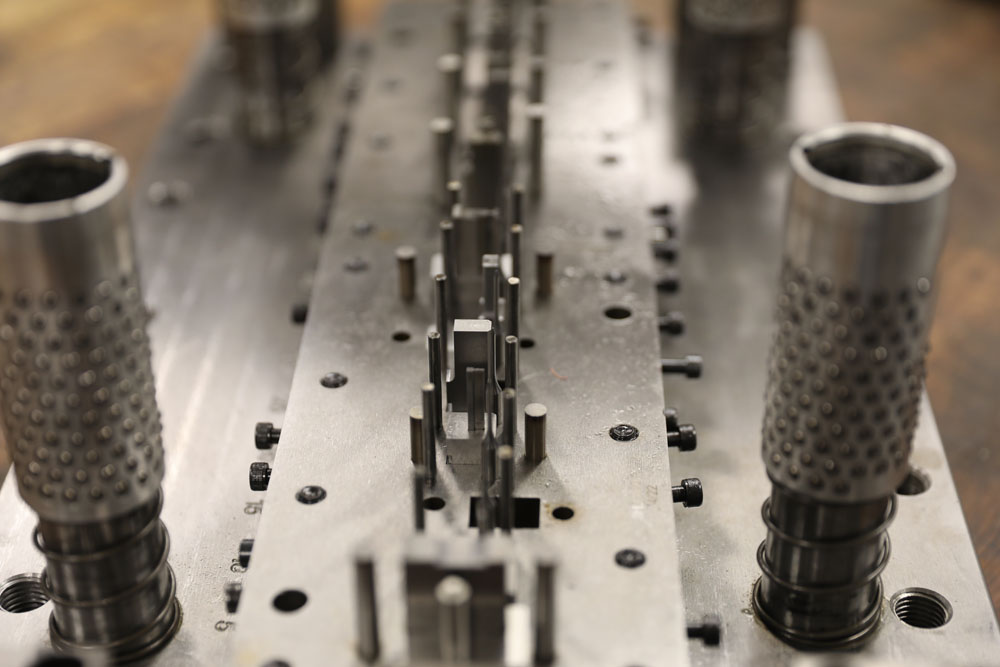
The process relies on advanced progressive die stamping, where a strip of material moves through a series of stations within the die. Each station performs a specific function, whether cutting, forming, or bending. In an assembly die, certain stations are dedicated to introducing and joining additional components into the part as it travels through the tool.
These added components might be fasteners, contacts, springs, or secondary metal pieces. The die positions and secures each element with precision, then the finished assembly is separated from the strip or wound onto a reel for downstream processing. Because everything happens inside a single tool, alignment stays consistent and human handling is essentially removed from the equation.
The Role of Progressive Die Stamping
Progressive die stamping is the foundation that makes In-Die Assembly possible. The progressive die’s multi-station design provides the space and sequencing needed to both form the part and assemble its components in a controlled, repeatable manner. Manufacturers with deep progressive die expertise can engineer tools that integrate assembly steps seamlessly into the stamping sequence, supported by in-die monitoring and computerized feedback that verify each operation in real time.
The Cost Advantages of In-Die Assembly
The primary appeal of In-Die Assembly is cost reduction, and it delivers savings across several areas of production.
By consolidating multiple operations into one, manufacturers eliminate the labor associated with separate assembly lines. Parts no longer need to be moved between machines, staged in inventory, or hand-assembled by operators. This reduction in handling lowers labor costs and removes a significant source of variation and potential damage.
In-Die Assembly also reduces tooling and equipment redundancy. Instead of investing in separate assembly fixtures and stations, the assembly function is built directly into the stamping tool. Over a long production run, this consolidation translates into meaningful per-part savings that compound at high volumes.
How In-Die Assembly Reduces Lead Time
Lead time is often just as critical as cost, and this is another area where In-Die Assembly delivers measurable results. Traditional production flows require parts to move through multiple stages, each with its own setup, queue time, and inspection. Every handoff between operations introduces delay.
By performing stamping and assembly simultaneously, In-Die Assembly collapses that timeline into a single pass. Finished assemblies come off the press ready for plating, packaging, or shipment. This streamlined flow shortens the path from raw material to finished product and helps manufacturers respond faster to demand. For programs with aggressive delivery schedules, the time saved by removing secondary assembly steps can be the difference between hitting a deadline and missing it.
Quality and Consistency Benefits
Beyond cost and speed, In-Die Assembly improves quality by reducing the number of times a part is handled. Each manual touch in a traditional process is an opportunity for misalignment, contamination, or damage. By assembling components within the die, those opportunities are largely eliminated.
The precision of the die ensures that every assembly is built to the same specification, run after run. Combined with in-line monitoring and inspection systems, this consistency produces tighter tolerances and lower defect rates than manual or semi-automated assembly methods can typically achieve. For industries where reliability is non-negotiable, this repeatability is a significant advantage.
When to Choose In-Die Assembly
In-Die Assembly is not the right fit for every part, but it excels under specific conditions. It is most valuable when a part requires multiple components joined together, when production volumes are high enough to justify the tooling investment, and when consistency and tight tolerances are critical to the application.
Parts that benefit most from this approach often share these characteristics:
- High annual volumes that reward per-part efficiency
- Multiple components that would otherwise require manual assembly
- Tight tolerance requirements that demand consistent positioning
- Applications where handling damage or contamination must be minimized
- Programs with compressed lead times and demanding delivery schedules
Working with an experienced manufacturer early in the design phase helps determine whether a part is a strong candidate and how the assembly steps can best be integrated into the tool.
Industries That Benefit from In-Die Assembly
A wide range of industries rely on In-Die Assembly to produce complex stamped assemblies efficiently. Automotive manufacturers use it for electrical contacts, terminals, and connector components produced in massive quantities. The electronics sector depends on it for connectors and shielding components that combine multiple elements. Medical, industrial, and energy applications also benefit when reliable, high-volume assembled components are required.
In each case, the value comes from producing finished stamped assemblies in a single operation rather than relying on slower, more error-prone downstream processes.
Partnering for In-Die Assembly Success
Successful In-Die Assembly depends on the capability of the manufacturing partner behind it. The process requires advanced die design, precision tooling, and integrated process control that not every shop can provide. A vertically integrated manufacturer that handles die design, progressive die stamping, assembly, and quality assurance in-house can engineer the entire process as a unified system.
This integration is what unlocks the full benefit of In-Die Assembly. When the same team designs the tool, runs the press, and verifies the output, there are fewer handoffs and tighter control over the finished stamped assemblies. The result is a production process that delivers lower costs, shorter lead times, and consistent quality from the first part to the last.
Streamlining Production From Stamp to Assembly
In-Die Assembly represents a smarter way to manufacture complex parts at scale. Merging stamping and assembly into one continuous operation, it removes the cost, delay, and risk associated with secondary processes. For engineers and manufacturers facing pressure to do more with less, In-Die Assembly offers a proven path to faster delivery, lower per-part cost, and dependable quality across every production run.
