



Professional Rotary vs Wireless PMU Tattoo Machines Compared
Tattooing has evolved from a niche craft into a mainstream art form, attracting thousands of new artists each year who are eager to develop their skills and build thriving careers. This surge in popularity has driven remarkable technological advancements in tattoo equipment, giving artists more options than ever before. Yet with so many choices available, one dilemma consistently surfaces for beginners and transitioning professionals alike: should you invest in a professional rotary tattoo machine or embrace the newer wireless PMU technology?
This decision carries significant weight. The machine you choose directly impacts your learning curve, the quality of your work, and ultimately your professional reputation. A well-suited tool accelerates skill development, while a poor match can lead to frustration and inconsistent results. In this comprehensive comparison, we break down the key differences between professional rotary and wireless PMU tattoo machines, examining their core technologies, performance characteristics, and suitability for beginners. Whether you prioritize precision, portability, or affordability, the insights ahead will help you make a confident, informed choice.
The Fundamentals of Professional Rotary Tattoo Machines
A professional rotary tattoo machine uses a small electric motor to drive a needle in a smooth, cyclical motion. Unlike traditional coil machines that rely on electromagnetic circuits to create a hammering action, rotary systems convert motor rotation directly into linear needle movement through a cam or connecting bar mechanism. This fundamental difference results in quieter operation, significantly less vibration, and more consistent needle penetration depth throughout extended sessions.
Rotary machines have come a long way since their early incarnations in the 1970s and 80s. Modern versions incorporate aerospace-grade materials, precision engineering, and advanced motor technology that make them suitable for every tattooing application—from fine linework and stippling to bold color packing and smooth shading. Their versatility and reliability have made them the dominant choice in professional studios worldwide.
Core Technology: Benefits of Coreless Motors
The coreless motor represents a significant leap forward in rotary machine design. Traditional motors contain an iron core wrapped in copper wire, which adds weight and generates substantial heat during operation. Coreless motors eliminate that iron core entirely, using a self-supporting copper coil that spins freely around a magnet. The result is a lighter, cooler-running power tattoo machine that responds instantly to voltage changes. For beginners, this translates to less hand fatigue during practice sessions and more predictable needle behavior, making it easier to develop consistent technique without fighting against the equipment.
Power and Precision in Rotary Systems
Rotary machines deliver power with remarkable steadiness. Because the motor maintains constant rotational speed regardless of skin resistance, the needle moves at a uniform rate that produces even ink distribution. Artists can fine-tune voltage to control needle speed and hitting force, allowing precise adjustments for different skin types and techniques. For new artists still developing their hand pressure and angle control, this consistency acts as a safety net—the machine compensates for minor technique variations rather than amplifying them, shortening the learning curve and building confidence faster.
Exploring the Wireless PMU Machine Revolution
Wireless PMU machines represent a paradigm shift in how artists approach permanent makeup and tattoo work. Originally designed for semi-permanent cosmetic procedures like microblading eyebrows, lip blushing, and eyeliner application, these compact devices have rapidly expanded into broader tattooing territory. Their defining characteristic is the elimination of power cords entirely—an integrated rechargeable battery powers the motor, freeing artists from the constraints of outlet proximity and cable management. This cord-free design, combined with pen-style ergonomics, has made wireless PMU machines enormously appealing to beginners who find traditional setups intimidating or cumbersome.

The growing popularity of these machines stems from their intuitive operation. Most models feature simple interfaces with clearly marked controls, allowing new artists to focus on technique rather than equipment management. Brands like Biomaser have contributed to this accessibility by offering wireless PMU devices with adjustable stroke capabilities and lightweight construction typically under 150 grams, bridging the gap between professional performance and accessibility in ways that weren’t possible just a few years ago.
The Advantage of Adjustable Stroke Settings
Adjustable stroke is perhaps the most valuable feature wireless PMU machines offer developing artists. Stroke length determines how far the needle extends and retracts with each cycle, directly affecting ink deposit depth and saturation. A shorter stroke (around 2.5mm) works beautifully for delicate linework and cosmetic procedures, while longer strokes (3.5mm or more) provide the punch needed for body tattooing and color packing. Rather than purchasing multiple machines for different tasks, beginners can experiment with a single device, discovering which settings produce the best results for various techniques and skin types. This flexibility transforms one tool into a comprehensive learning platform.
Wireless Freedom: Enhancing Artist Mobility
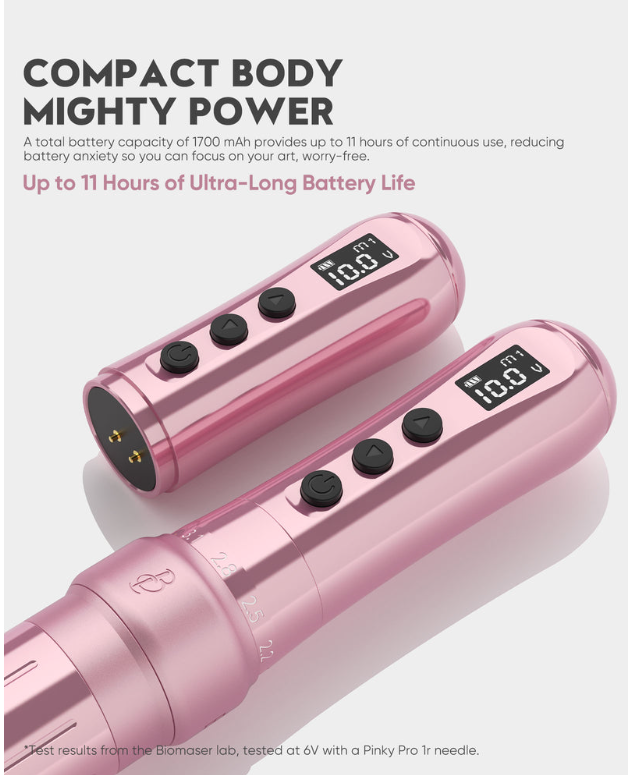
The absence of a power cord fundamentally changes how artists interact with their workspace. Without cables tethering them to a power supply, artists can reposition freely around clients, work at unconventional angles, and set up in virtually any location—from studio appointments to guest spots and conventions. For beginners practicing on synthetic skin at home, this means no tangled cords, no searching for outlets, and a cleaner workspace that reduces distractions. Battery life on quality wireless PMU machines typically ranges from three to eight hours of continuous use, sufficient for most session lengths. The portability factor also makes these machines ideal for artists building mobile businesses or those who haven’t yet committed to a permanent studio space.
Head-to-Head Comparison: Rotary vs. Wireless PMU Features
When placed side by side, professional rotary and wireless PMU machines reveal distinct strengths that matter in daily practice. Noise level is an immediate differentiator—rotary machines run quietly compared to coil machines, but wireless PMU devices tend to operate even more silently due to their smaller motors and enclosed housing. For beginners working from home or shared spaces, this reduced sound output minimizes distractions and creates a calmer environment for concentration. Vibration follows a similar pattern; both machine types produce far less hand buzz than coil alternatives, though rotary machines with direct-drive systems may transmit slightly more feedback through the grip, which some artists actually prefer as tactile confirmation of needle activity.
Weight distribution differs meaningfully between the two categories. Professional rotary machines typically weigh between 150 and 250 grams depending on frame material, while wireless PMU pens often stay below 150 grams but carry their battery weight internally, creating a balanced center of gravity. Speed control on corded rotary machines responds instantly to power supply adjustments, whereas wireless models rely on onboard electronics that occasionally introduce minimal lag. Battery life remains the obvious trade-off for wireless convenience—once depleted mid-session, artists must either swap batteries or pause to recharge, a limitation corded rotary machines simply never face.
Performance Metrics: Speed, Torque, and Consistency
Torque—the motor’s ability to maintain needle speed under resistance—separates professional-grade equipment from entry-level tools. High-quality rotary machines excel here, delivering consistent puncture force even when working through tough skin areas like elbows or ribcages. Their motors sustain high RPM without bogging down, ensuring uniform line weight and saturation across an entire piece. Wireless PMU machines have improved dramatically in this regard, but compact battery-powered motors can still struggle with demanding color-packing sessions that require sustained high torque over hours. For beginners practicing basic linework and small designs on synthetic skin or cooperative body areas, both machine types perform admirably. However, artists planning to tackle larger, more complex projects will appreciate the rotary’s unwavering power delivery during extended work.
Durability and Maintenance: Long-Term Considerations
Build quality determines how well your investment holds up over months and years of regular use. Professional rotary machines constructed from aircraft-grade aluminum or stainless steel frames withstand drops, sterilization protocols, and thousands of operating hours with minimal degradation. Their maintenance is straightforward—periodic lubrication of moving parts and occasional motor replacement after extensive use. Wireless PMU machines introduce battery longevity as an additional concern; lithium-ion cells degrade over charge cycles, eventually holding less capacity and requiring replacement. The sealed electronic components in wireless devices can also be more difficult to service independently. For budget-conscious beginners, a well-maintained rotary machine may offer better long-term value despite higher initial cost, while wireless PMU machines provide lower entry barriers with the understanding that battery modules may need periodic replacement as part of ongoing ownership costs.
Catering to Beginner Tattoo Artists: Needs and Solutions
Breaking into tattooing presents unique challenges that the right equipment can either ease or intensify. Beginners typically need machines that forgive minor technique errors, respond predictably to input, and allow gradual skill progression without overwhelming complexity. Both professional rotary and wireless PMU machines address these needs, though they do so through different approaches. The key lies in matching your specific learning priorities—whether that means prioritizing versatility, simplicity, or budget—with the machine category that best delivers on those fronts.
User-Friendly Features for Easy Learning
Ergonomic design matters enormously when you’re spending hours practicing strokes on synthetic skin. Wireless PMU machines excel here with their pen-style grip that mimics the feel of drawing instruments most people already know how to hold. This familiar form factor reduces the mental adjustment period and lets beginners focus purely on needle depth and hand speed. Professional rotary machines counter with adjustable grip sizes and customizable needle configurations that grow with your abilities. Quiet operation benefits beginners in both categories—less noise means less anxiety during early practice sessions and a calmer headspace for developing muscle memory. Intuitive controls, whether a simple dial on a rotary power supply or clearly labeled buttons on a wireless unit, prevent the frustration of fumbling with settings when concentration should remain on the skin surface.
Affordable Options with Adjustable Settings
Budget constraints are real for most beginners, and fortunately both machine categories offer entry-level options that don’t sacrifice essential adjustability. Look for wireless PMU machines with variable stroke length and speed control—these two features alone provide enough range to practice linework, shading, and basic color work without buying additional equipment. In the rotary category, machines compatible with standard cartridge needle systems save money over time since cartridges are widely available and competitively priced. When evaluating value, prioritize machines from established manufacturers that offer replacement parts and customer support. Avoid the cheapest unbranded options that may lack consistent quality control, as unreliable equipment teaches bad habits by forcing you to compensate for mechanical inconsistencies rather than developing clean technique.
Step-by-Step Guide to Getting Started
Begin by honestly assessing where you stand. If you’ve never held a tattoo machine, start with synthetic practice skin and a single machine rather than investing in a full kit you don’t yet understand. Set a realistic budget that includes not just the machine but also needles, ink, practice skin, and hygiene supplies. Next, research two or three machines within your budget and watch unbiased video reviews showing them in actual use—pay attention to how they sound, how artists hold them, and what results they produce on skin. If possible, visit a tattoo supply shop or convention where you can physically handle different machines to assess weight and balance. Once you’ve made your purchase, commit to structured practice: dedicate sessions to single techniques like straight lines or consistent dots before attempting complex designs. Track your progress through photos, adjust your machine settings methodically between sessions, and don’t hesitate to seek feedback from experienced artists in online communities or local mentorship programs.
How to Select Your Ideal Tattoo Machine: A Practical Guide
Choosing between a professional rotary and a wireless PMU machine ultimately comes down to aligning your equipment with your personal workflow, artistic direction, and practical circumstances. Rather than asking which machine is objectively better, ask which machine serves your specific situation best right now while leaving room for growth. A structured evaluation process eliminates guesswork and prevents costly mistakes that many beginners make when purchasing based solely on brand hype or social media recommendations.
Assessing Your Tattooing Style and Goals
Your artistic focus should drive your machine selection more than any other factor. If you’re drawn to fine linework, geometric patterns, or cosmetic procedures like brow work and lip color, a wireless PMU machine with adjustable stroke gives you the precision and portability these styles demand. Artists gravitating toward larger illustrative pieces, bold traditional work, or heavy black-and-grey realism will benefit from the sustained torque and power consistency of a professional rotary machine. Consider where you want to be in twelve months—if your goal is building a mobile PMU business, wireless makes strategic sense from day one. If you envision yourself working full sessions in a studio environment tackling diverse projects, a corded rotary provides the reliability and power range that ambitious work requires. Many successful artists eventually own both, but starting with the one that matches your primary direction prevents scattered skill development.
Budget Considerations and Value for Money
Smart budgeting means thinking beyond the purchase price. A quality wireless PMU machine may cost less upfront but factor in battery replacements every one to two years and potentially limited repairability. A professional rotary machine carries a higher initial investment but often lasts five or more years with basic maintenance, spreading that cost across thousands of hours of use. Allocate roughly sixty percent of your equipment budget to the machine itself and reserve the rest for cartridge needles, quality ink, practice supplies, and a decent power supply if going corded. Avoid financing multiple cheap machines when one reliable mid-range device teaches you more effectively. Check whether manufacturers offer warranty coverage, accessible replacement parts, and responsive customer service—these factors become invaluable when something inevitably needs attention. The best value lies not in the lowest price tag but in the machine that keeps performing consistently as your skills advance, eliminating the need for premature upgrades.
Choosing the Right Machine for Your Tattoo Career
Professional rotary and wireless PMU tattoo machines each bring distinct advantages to the table, and neither is universally superior—the right choice depends entirely on your circumstances. Rotary machines deliver unmatched torque consistency, sustained power for demanding sessions, and long-term durability that justifies their higher initial cost. Wireless PMU machines counter with intuitive pen-style ergonomics, cord-free mobility, and adjustable stroke versatility that makes them exceptional learning platforms for beginners exploring multiple techniques with a single device.
For new artists, both categories now offer user-friendly designs and affordable entry points that didn’t exist a decade ago. The critical step is honest self-assessment: identify your artistic direction, evaluate your working environment, and set a realistic budget that accounts for ongoing supplies and maintenance. Let those answers guide your purchase rather than trends or impulse. As tattoo technology continues advancing at a rapid pace, the artists who thrive will be those who choose tools aligned with their vision and commit to mastering them through deliberate, consistent practice. Your machine is a partner in your creative journey—select it with intention, and it will serve you well.


