

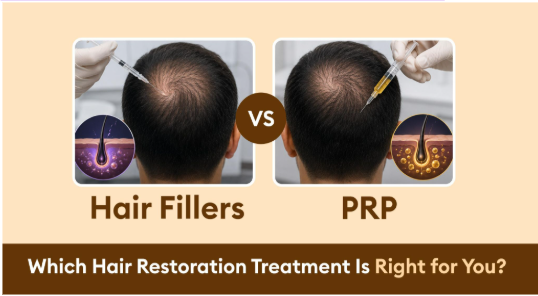
Hair loss affects millions of people worldwide and remains one of the most common concerns seen in aesthetic and dermatology clinics. As non-surgical hair restoration treatments continue to evolve, patients today have access to more options than ever before.
Two treatments that are frequently discussed are Platelet-Rich Plasma (PRP) and Elyara Hair Filler.
While both are injectable procedures designed to support hair restoration, they are built on very different scientific principles. Understanding these differences can help patients and practitioners evaluate which approach may be most appropriate based on individual treatment goals.
Quick Comparison
| Feature | PRP | Elyara Hair Filler |
| Treatment Category | Platelet-based therapy | Hair filler |
| Source | Patient’s own blood | Ready-to-use formulation |
| Technology | Concentrated platelets and growth factors | 7 biomimetic peptides + hyaluronic acid |
| Blood Draw Required | Yes | No |
| Delivery System | Direct injection | Sustained-release peptide delivery |
| Biological Focus | Growth factor stimulation | Multi-pathway regenerative signaling |
| Standardization | Varies by patient | Consistent formulation |
| Procedure Type | Non-surgical | Non-surgical |
| Downtime | Minimal | Minimal |
What Is PRP?
Platelet-Rich Plasma (PRP) is one of the most widely used regenerative hair restoration treatments.
The procedure begins with a blood draw. The blood is then processed through centrifugation to separate and concentrate platelets. These platelets contain naturally occurring growth factors that are involved in tissue repair and cellular communication.
The concentrated plasma is injected into areas of the scalp affected by hair thinning.
PRP gained popularity because it utilizes material derived directly from the patient, making it one of the earliest regenerative therapies adopted in aesthetic medicine.
What Is Elyara Hair Filler?
Elyara Hair Filler is a CE-approved injectable hair filler developed specifically for hair restoration and scalp regeneration.
The formulation combines hyaluronic acid with seven patented biomimetic peptides and utilizes a double-encapsulation delivery platform designed to provide sustained peptide release within the scalp.
Unlike treatments centered primarily around growth factor delivery, Elyara was developed around a multi-pathway regenerative model intended to support several biological mechanisms involved in hair growth and follicular health.
The formulation was specifically designed to support pathways associated with:
- Hair growth activation
- Follicular preservation
- Hair cycle regulation
- Scalp regeneration
- Extracellular matrix support
- Scalp environment optimization
Understanding the Difference in Biological Approach
The biggest difference between PRP and Elyara Hair Filler is how they attempt to influence hair biology.
PRP: Growth Factor Therapy
PRP works by delivering concentrated growth factors obtained from the patient’s own platelets.
Growth factors act as biological messengers involved in:
- Tissue repair
- Cellular communication
- Wound healing
- Regenerative processes
The goal is to increase the concentration of these naturally occurring signals within the scalp environment.
Elyara Hair Filler: Biomimetic Peptide Therapy
Elyara Hair Filler utilizes biomimetic peptides engineered molecules designed to mimic specific biological signals associated with hair growth and follicular function.
Rather than relying primarily on growth factor stimulation, the formulation incorporates seven peptides designed to interact with multiple pathways involved in hair restoration.
This reflects a growing trend within regenerative medicine toward targeted biological signaling and pathway-specific intervention.
PRP vs Elyara: Standardization Matters
One of the challenges often discussed with autologous therapies such as PRP is variability.
Because PRP is derived from a patient’s own blood, the concentration of platelets and growth factors can differ between individuals.
Factors such as:
- Age
- Health status
- Hydration
- Medications
- Biological variation
can influence the composition of the final preparation.
Elyara Hair Filler, by contrast, is supplied as a standardized formulation containing a defined peptide complex and delivery system.
For practitioners seeking consistency in formulation and protocol, this represents a fundamentally different treatment approach.
The Evolution Beyond Growth Factors
Growth factors represented an important step forward in regenerative hair restoration.
However, advances in hair biology have revealed that hair loss is not driven by a single pathway.
Processes associated with:
- Follicular activation
- Hair cycle regulation
- Stem cell signaling
- Extracellular matrix support
- Follicular miniaturization
- Scalp tissue quality
may all influence long-term hair health.
As a result, newer technologies are increasingly being developed to address multiple biological mechanisms simultaneously.
A Closer Look at Elyara’s Multi-Pathway Design
One of the defining characteristics of Elyara Hair Filler is its seven-peptide architecture.
The formulation incorporates biomimetic peptides associated with several mechanisms relevant to hair restoration.
Hair Growth Activation
Certain peptides are designed to support pathways associated with follicular activation and maintenance of the growth phase of the hair cycle.
Follicular Preservation
Other peptides are associated with pathways linked to follicular miniaturization and biological processes commonly involved in androgenetic hair loss.
Scalp and Extracellular Matrix Support
Additional peptides are intended to support collagen production, extracellular matrix integrity, and the biological environment surrounding the follicle.
Together, these mechanisms reflect a broader regenerative strategy rather than reliance on a single category of signaling molecules.
Sustained Release vs Immediate Delivery
Another key difference lies in delivery technology.
PRP delivers growth factors directly following injection.
Elyara Hair Filler utilizes a double-encapsulation system designed to support sustained peptide release within the scalp over an extended period.
This approach reflects the growing interest in maintaining biological signaling beyond the initial treatment session rather than relying solely on immediate exposure to active ingredients.
Treatment Experience
Both treatments are minimally invasive and performed in a clinical setting.
PRP
- Requires blood collection
- Blood processing before treatment
- Multiple injections
- Minimal downtime
Elyara Hair Filler
- Ready-to-use formulation
- No blood draw required
- Multiple injections
- Minimal downtime
Most patients are able to return to normal activities shortly after either procedure.
Who May Consider PRP?
PRP may appeal to individuals who:
- Prefer autologous treatments
- Are interested in platelet-derived growth factors
- Are comfortable with blood collection procedures
- Are seeking non-surgical hair restoration options
Who May Consider Elyara Hair Filler?
Elyara Hair Filler may appeal to individuals who:
- Are interested in peptide-based regenerative medicine
- Prefer a standardized formulation
- Want a treatment designed around multiple biological pathways
- Are seeking advanced regenerative technologies
- Wish to support both scalp health and follicular activity
Which Treatment Is More Advanced?
Both PRP and Elyara Hair Filler belong to the regenerative medicine category.
However, they represent different generations of technology.
PRP introduced the concept of utilizing naturally occurring biological signals to support hair restoration.
Elyara Hair Filler reflects the industry’s movement toward targeted regenerative platforms that combine biomimetic peptide technology, sustained-release delivery systems, and multi-pathway biological support.
For this reason, many practitioners view peptide-based regenerative therapies as part of the next evolution of non-surgical hair restoration.
Final Thoughts
PRP and Elyara Hair Filler are both non-surgical approaches designed to support hair restoration, but they differ significantly in formulation and biological strategy.
PRP focuses on delivering concentrated growth factors derived from the patient’s own blood. Elyara Hair Filler utilizes seven biomimetic peptides, a hyaluronic acid scaffold, and sustained-release technology designed to support multiple pathways associated with hair growth, follicular health, and scalp regeneration.
As understanding of hair biology continues to advance, treatment selection is increasingly shifting from single-pathway interventions toward more comprehensive regenerative approaches.
For patients evaluating modern hair restoration options, understanding the underlying technology may be just as important as understanding the procedure itself.
Frequently Asked Questions
Is Elyara Hair Filler the same as PRP?
No. PRP uses concentrated platelets and growth factors derived from the patient’s blood, while Elyara Hair Filler utilizes a biomimetic peptide platform and sustained-release technology.
Does Elyara require a blood draw?
No. Elyara Hair Filler is supplied as a ready-to-use formulation and does not require blood collection.
Which treatment targets more biological pathways?
PRP primarily focuses on growth factor delivery, while Elyara Hair Filler was developed around a multi-pathway regenerative architecture designed to support several biological mechanisms associated with hair growth and follicular health.
Can patients who have already tried PRP consider Elyara Hair Filler?
Treatment suitability should always be determined by a qualified practitioner based on individual patient needs and treatment goals.
Why are peptide-based treatments becoming more popular?
Advances in regenerative medicine have increased interest in biomimetic peptides because they can be designed to interact with specific biological pathways associated with tissue regeneration and cellular signaling.
