

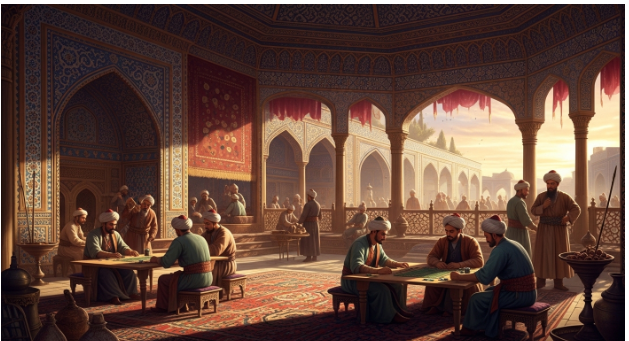
Throughout history, trade was never limited to the exchange of goods alone. On the caravan routes of the Silk Road, merchants carried more than silk, spices and precious stones across thousands of kilometres they carried with them the culture of dice, cards and betting.
The Road Itself Was a Gamble
By any modern measure, the journey from Istanbul to Samarkand is staggering. Thousands of kilometres of desert, mountain and steppe. Months-long expeditions. Bandit raids, storms, disease.
For a merchant setting out on the Silk Road, the journey itself was the greatest wager of all. Every coin of capital was at risk. Return was never guaranteed. Within this mental framework, it becomes easy to understand why gambling games played at caravanserais each night were so universally popular. Risk was already woven into daily life.
Nights at the Caravanserai
The caravanserais scattered across Anatolia were far more than rest stops. They were social centres where merchants from different cultures, languages and faiths converged under one roof.
Dice games around the evening fire were inevitable. Arab merchants brought their own games, Persians their chess pieces, Turkish and Mongol traders their knucklebone dice carved from sheep astragali. These dice were so widespread that archaeologists still find them today among the ruins of Anatolian caravanserais.
Bets started small a few silver coins, a measure of spice, sometimes a pack animal. But the records show that some merchants staked entire cargo loads on a single night’s play.
Istanbul: The Crossroads of Eastern and Western Gambling
At the western end of the Silk Road, Istanbul was as much a crossroads of gambling culture as it was of trade. When Venetian and Genoese merchants settled in Galata, they brought card games with them. Merchants arriving from the East brought dice and board games.
Within this cosmopolitan structure inherited from the Byzantine period into the Ottoman era, venues functioning as gambling houses retreated into the cellars of trading hans, harbour taverns and private residences. Legal prohibition never aligned with practical reality.
The traveller Marco Polo, passing through Istanbul in the 13th century, noted that high-stakes games were played every night in the city’s trading hans. Winners funded the capital for their next trading expedition. Losers sometimes pledged repayment from the proceeds of future caravans.
Samarkand: At the Other End of the Road
Samarkand was one of the most brilliant cities on the Silk Road. At its peak during the Timurid period, it ranked among the wealthiest trading centres in the world — and here, betting culture reached its most sophisticated form.
In Samarkand’s bazaars, it was not only goods that changed hands. Races, wrestling contests and chess tournaments all attracted serious wagers. Chess was taken so seriously at Timur’s court that large bets were considered perfectly normal. Some historians argue that Timur developed his strategic thinking at the chessboard.
Dice Culture Across the Central Asian Steppe
In the steppes at the heart of the Silk Road, betting was an organic part of daily life among Turkic and Mongol communities. Traditional contests — horse racing, wrestling, archery — were always intertwined with wagering.
This culture travelled to Anatolia through migration and trade routes. Turkic communities settling in Anatolia during the Seljuk period integrated this tradition into urban life. Even in the Ottoman palace archives, records exist of high-ranking statesmen organising private gambling gatherings.
A Legacy That Reaches the Present
The Silk Road is no longer an active trade route. But the risk-taking culture shaped along that road continues to live on across Turkish geography in different forms.
Today’s online gaming platforms in Turkey are the digital extension of the social tradition that began in caravanserais centuries ago. Just as Silk Road merchants sought reliable stopping points along their route, today’s players seek accessible and trustworthy platforms. VegasSlot giriş yap stands out as a functional stop on this modern route.
The Silk Road was not merely a trade network it was a living space where people took risks, tested their luck and wove their cultures together. Gambling was an inseparable part of that life. This legacy, buried in the dusty pages of history, offers an important window for understanding the roots of today’s betting culture.
