

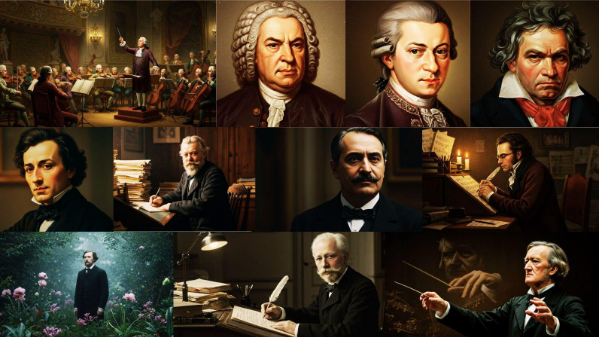
Discover the secret lives of classical composers. Unveil hidden stories behind iconic musicians. Dive into their struggles and groundbreaking innovations.
Classical music is a treasure trove of timeless masterpieces, and the composers behind these works are legends in their own right. The secret lives of classical composers offer a fascinating glimpse into the minds and motivations of some of the world’s most beloved musical geniuses. This article delves into the hidden stories behind iconic musicians, revealing the people behind the music. From their struggles to their groundbreaking innovations, these composers’ lives are as captivating as their compositions. So, let’s explore the secret lives of classical composers and uncover the hidden gems that make their music timeless.
Who Were the Classical Composers?
The Big Names
The world of classical music is home to many legendary composers. Let’s start with the big names that have left an indelible mark on the musical landscape.
Ludwig van Beethoven
Ludwig van Beethoven (1770-1827) was a German composer and pianist whose life and work profoundly influenced Western classical music. Born in Bonn, Beethoven’s journey from child prodigy to one of history’s most revered composers was marked by both extraordinary talent and significant personal challenges.
Early Life and Musical Beginnings
- Born on December 16, 1770, in Bonn, Germany
- Showed exceptional musical talent from a young age
- Initially taught by his father, Johann van Beethoven, who was often harsh and abusive
- By age 12, Beethoven was earning a living as an organist and composer
Musical Career and Innovations
- Moved to Vienna in 1792 to study with Joseph Haydn
- Quickly gained a reputation as a virtuoso pianist and gifted composer
- Composed over 600 works across various genres
- Notable works include:
- Nine symphonies, including the revolutionary “Eroica” (Third Symphony) and the iconic Ninth Symphony with its “Ode to Joy” finale
- Piano concertos, string quartets, and numerous piano sonatas
- His only opera, “Fidelio”
Hearing Loss and Resilience
- Began experiencing hearing problems around 1798, at age 27 or 28
- Hearing deteriorated gradually over about 20 years
- By his mid-40s, Beethoven was completely deaf
- Despite this challenge, he continued to compose, including some of his most famous works
- The Ninth Symphony was composed when Beethoven was completely deaf
Personal Life
- Never married
- Proposed to several women but was rejected
- Known for his difficult personality and temper
- Struggled with health issues throughout his life
Ludwig van Beethoven died in Vienna on March 26, 1827, at the age of 56. Despite the challenges he faced, particularly his progressive hearing loss, Beethoven’s musical genius and innovative compositions left an indelible mark on classical music, influencing generations of composers and musicians to come.
Wolfgang Amadeus Mozart
Wolfgang Amadeus Mozart (27 January 1756 – 5 December 1791) was a prolific and influential composer of the Classical period. Born in Salzburg, Austria, Mozart’s exceptional musical talent emerged at an astonishingly early age, leading to a legacy that continues to captivate audiences worldwide.
Early Life and Prodigious Talent
Mozart’s musical journey began remarkably early:
- At age three, he was picking out chords on the harpsichord.
- By four, he was playing short pieces and began formal music education under his father, Leopold Mozart.
- At five, he had already started composing and performing before European royalty.
Leopold Mozart, a skilled violinist and composer himself, recognized his son’s extraordinary abilities and became his primary teacher[5]. The young Mozart’s talent was so remarkable that by age six, he was entertaining people with his keyboard skills and writing his first compositions.
Musical Education and Development
Contrary to some beliefs, Mozart did receive formal musical instruction:
- His father, Leopold, was his primary teacher, instructing him not only in music but also in languages and academic subjects.
- Mozart likely received additional instruction from well-known composers and musicians of the time, including Johann Christian Bach and Franz Joseph Haydn.
By the age of eight, Mozart had written his first symphony, though it was likely transcribed by his father. His rapid progress in composition and performance led to grand tours of Europe, exposing him to a wide variety of musical styles and influences.
Career and Compositions
Mozart’s career was marked by prolific composition and innovation:
- He composed over 600 works, spanning virtually every classical genre of his time.
- His compositions include symphonies, concertos, operas, and chamber music.
- Notable works include “The Magic Flute,” “Don Giovanni,” and “Eine Kleine Nachtmusik”.
Mozart’s music is celebrated for its melodic beauty, formal elegance, and rich harmony and texture. His ability to compose rapidly and his proficiency across multiple instruments contributed to his vast musical output.
Personal Life
Mozart’s personal life differed from the initial description:
- He married Constanze Weber on August 4, 1782, at the age of 26.
- They had six children, but only two survived infancy.
Despite a short life marked by financial struggles and health issues, Mozart’s creative output remained remarkably consistent.
Wolfgang Amadeus Mozart died on December 5, 1791, at the age of 35, leaving behind a musical legacy that continues to inspire and influence composers and musicians to this day.
Johann Sebastian Bach
Johann Sebastian Bach was a German composer and organist. Born in Eisenach in 1685, Bach’s music is known for its complexity and technical virtuosity. He composed over 1,100 works, including cantatas, concertos, and organ pieces. Bach’s music is a cornerstone of the classical music repertoire, and his techniques for counterpoint and harmony continue to influence composers today. Bach’s secret lives of classical composers are a testament to his enduring legacy.
Bach’s early life was marked by talent and opportunity. He was a child prodigy, composing his first cantata at the age of ten. His father, a musician, recognized his son’s talent and encouraged him to study music. Bach’s father also arranged for him to study with some of the best musicians of the time, including Johann Pachelbel and Georg Böhm. Bach’s early life was a time of extraordinary talent and creativity.
Bach’s music is known for its complexity and technical virtuosity. His cantatas, concertos, and organ pieces are still performed and admired today. His most famous works include “The Brandenburg Concertos,” “The Well-Tempered Clavier,” and “The Mass in B minor.” Bach’s music is a cornerstone of the classical music repertoire, and his techniques for counterpoint and harmony continue to influence composers today.
Johann Sebastian Bach actually had 20 children in total, not 12, across two marriages. Here’s a breakdown:
- With his first wife, Maria Barbara Bach, he had 7 children, of whom 4 survived to adulthood
- With his second wife, Anna Magdalena Wilcke, he had 13 children
The high number of children was typical for the time. Childhood mortality was extremely high in 18th-century Germany, with nearly half of all children dying before their fifth birthday. Of Bach’s 20 children:
- 10 children died in early childhood
- 10 children survived to adulthood
- 4 of these surviving children became notable musicians and composers[3][6]
The four famous musical sons were:
- Wilhelm Friedemann Bach
- Carl Philipp Emanuel Bach
- Johann Christoph Friedrich Bach
- Johann Christian Bach
Pyotr Ilyich Tchaikovsky
Pyotr Ilyich Tchaikovsky (1840-1893) was a Russian composer whose music is known for its emotional depth and romanticism. Born in Votkinsk, he composed over 150 works, including symphonies, concertos, and ballets. Tchaikovsky’s music bridges the Classical and Romantic eras, and his works continue to be performed and admired worldwide. His enduring influence is a testament to his genius.
Early Life
Tchaikovsky’s early life was marked by talent and opportunity. He was a child prodigy, composing his first symphony at the age of 15. His father, a mining engineer, recognized his son’s talent and encouraged him to study music. Tchaikovsky’s father also arranged for him to study with some of the best musicians of the time, including Nikolai Rubinstein and Anton Rubinstein. Tchaikovsky’s early life was a time of extraordinary talent and creativity, setting the stage for his extraordinary achievements.
Musical Career
Tchaikovsky’s music is known for its emotional depth and romanticism. His symphonies, concertos, and ballets are still performed and admired today. His most famous works include “Swan Lake,” “The Nutcracker,” and “The Sleeping Beauty.” Tchaikovsky’s music is a bridge between the Classical and Romantic eras, and his works continue to be performed and admired worldwide.
Personal Life
Tchaikovsky’s personal life was also marked by talent and opportunity. He was married at the age of 30 to Antonina Milyukova, a singer. Tchaikovsky’s personal life was a time of extraordinary talent and creativity, and his music continues to inspire and captivate audiences today.
Clara Schumann
Clara Schumann (1819-1896) was a German pianist and composer whose talent and dedication left an enduring legacy. Born in Leipzig, she was married to the composer Robert Schumann. Despite her husband’s mental health struggles, Schumann supported him and continued to compose. Her piano music is known for its emotional depth and technical brilliance. Her enduring legacy is a testament to her genius and dedication.
Early Life
Schumann’s early life was marked by talent and opportunity. She was a child prodigy, composing her first piano piece at the age of eight. Her father, a musician, recognized her daughter’s talent and encouraged her to study music. Schumann’s father also arranged for her to study with some of the best musicians of the time, including Friedrich Wieck and Carl Czerny. Schumann’s early life was a time of extraordinary talent and creativity, setting the stage for her remarkable achievements.
Musical Career
Schumann’s piano music is known for its emotional depth and technical brilliance. Her piano pieces are still performed and admired today. Her most famous works include “Fantaisie in C major,” “Papillons,” and “Träumerei.” Schumann’s piano music is a cornerstone of the Romantic music repertoire, and her techniques for melody, harmony, and form continue to influence composers today.
Personal Life
Schumann’s personal life was also marked by talent and opportunity. She was married at the age of 20 to Robert Schumann, a composer. Their marriage was not always easy, as Robert struggled with mental health issues. Despite this, Clara supported her husband and continued to compose, leaving a lasting legacy in the world of classical music. Her unwavering support and dedication to her husband’s well-being, despite his struggles, are a testament to her character and commitment.
Frédéric Chopin
Frédéric Chopin (1810-1849) stands as one of the most influential composers and pianists of the Romantic era. Born in Żelazowa Wola, Poland, Chopin’s musical genius left an indelible mark on the world of classical music, with his compositions still captivating audiences nearly two centuries later[1].
Early Life and Prodigious Talent
Chopin’s musical journey began at a remarkably early age. Born to Nicholas Chopin, a French émigré working as a tutor, and Justyna Krzyzanowska, young Frédéric was immersed in a cultured environment from birth. By the age of four, he was already playing the piano, and at six, he was composing his tunes.
Recognizing his extraordinary talent, Chopin’s parents arranged for him to study under Wojciech Żywny, a respected musician. However, the young prodigy quickly surpassed his teacher in both technique and imagination[2]. By 1818, at just eight years old, Chopin was performing in elegant salons and composing pieces like the Polonaise in G Minor.
Musical Education and Early Career
Chopin’s formal musical education began at the Warsaw Conservatory of Music in 1826, where he studied under Polish composer Józef Elsner for three years[2]. This period was crucial in shaping his compositional style and technique.
In 1829, at the age of 19, Chopin made his performance debut in Vienna, where audiences were enthralled by his technically brilliant yet poetically expressive performances. This marked the beginning of his international career, leading him to perform across Poland, Germany, and Austria, and eventually settling in Paris in 1832.
Artistic Maturity and Compositional Style
Chopin’s time in Paris proved to be the most productive period of his life. He quickly established relationships with other young composers, including Franz Liszt, Vincenzo Bellini, and Felix Mendelssohn. Although his delicate style didn’t always resonate with large concert audiences, Chopin found his niche in the great parlors of Paris as both a recitalist and teacher.
His compositions during this period included masterpieces such as:
- Nocturnes of Opp. 9 and 15
- Scherzo in B-flat minor, Op. 31
- Sonata in B-flat minor, Op. 35
Chopin’s music is characterized by its emotional depth, technical virtuosity, and innovative use of harmony and melody. His works, including nocturnes, mazurkas, and waltzes, remain cornerstones of the Romantic repertoire.
Personal Life and Legacy
Contrary to the original paragraph, Chopin never married Maria Wodzińska or had children. His most significant personal relationship was with French novelist George Sand (Aurore Dupin), which lasted from 1838 to 1847.
Throughout his life, Chopin struggled with poor health, ultimately succumbing to tuberculosis in Paris in 1849 at the age of 39. Despite his short life, Chopin’s impact on music has been profound and lasting. His innovative approach to piano technique, harmony, and musical form continues to influence composers and captivate audiences worldwide.
Chopin’s legacy as a composer and pianist remains undiminished, cementing his status as one of the greatest composers of the Romantic era. His music continues to be performed, studied, and cherished, a testament to his enduring genius and the timeless beauty of his compositions.
Antonio Vivaldi
Antonio Vivaldi (1678-1741) was an Italian composer and virtuoso violinist who left an indelible mark on Baroque music. Born in Venice on March 4, 1678, Vivaldi’s contributions to music continue to influence and inspire audiences and composers to this day.
Early Life and Musical Beginnings
- Born into a musical family in Venice
- Father, Giovanni Battista Vivaldi, was a violinist at St. Mark’s Basilica
- Showed exceptional musical talent from a young age
- Began studying for the priesthood at age 15, ordained in 1703
- Nicknamed “Il Prete Rosso” (The Red Priest) due to his red hair
Musical Career and Achievements
- Composed over 500 concertos, along with numerous operas and sacred choral works
- Appointed as violin master at the Ospedale della Pietà in 1703
- Most famous work: “The Four Seasons” (part of Op. 8 “Il cimento dell’armonia e dell’inventione”)
- Other notable works include:
- “Gloria” (RV 589)
- “L’estro armonico” (Op. 3)
- “La stravaganza” (Op. 4)
- Pioneered developments in orchestration, violin technique, and programmatic music
- Influenced many composers across Europe
Personal Life
Contrary to the original text, several corrections are necessary:
- Vivaldi never married and had no children
- As a priest, he was bound by vows of celibacy
- Health issues (possibly asthma) prevented him from saying Mass regularly
- Spent most of his career at the Ospedale della Pietà, teaching and composing for the girls there
Vivaldi’s life was indeed marked by extraordinary talent and creativity. His music, known for its emotional depth and technical brilliance, continues to captivate audiences nearly three centuries after his death. Vivaldi died in Vienna on July 28, 1741, leaving behind a legacy that would be rediscovered and celebrated in the 20th century.
George Frideric Handel
George Frideric Handel (1685-1759) was a German-British Baroque composer renowned for his operas, oratorios, anthems, concerti grossi, and organ concertos. Born in Halle, Germany, on February 23, 1685, Handel’s music is indeed known for its complexity, technical virtuosity, and emotional depth.
Early Life and Musical Beginnings
- Handel showed exceptional musical talent from a young age
- His father, Georg Händel, initially opposed a musical career for his son
- Young Handel secretly practiced on a clavichord hidden in the attic
- At age 9, his talent was recognized by the Duke of Saxe-Weissenfels
- Began studying with Friedrich Wilhelm Zachow, a renowned organist and composer
- By age 10, Handel could compose for organ, oboe, and violin
Musical Career and Achievements
- Composed over 600 works, including 42 operas and 24 oratorios
- Moved to London in 1712, where he spent most of his career
- Became a naturalized British subject in 1727
- Notable works include:
- “Messiah” (1742)
- “Water Music” (1717)
- “Music for the Royal Fireworks” (1749)
- Composed four coronation anthems, including “Zadok the Priest”
- Transitioned from Italian opera to English oratorios in the 1730s
Personal Life
- Handel never married and had no children
- Suffered a stroke in 1737 but recovered and continued composing
- Became blind in old age but continued to work
- Died on April 14, 1759, in London
- Given a state funeral and buried in Westminster Abbey
Handel’s music remains a cornerstone of the Baroque repertoire, and his influence on subsequent composers is undeniable. His ability to blend German, Italian, and English musical styles created a unique and enduring legacy in Western classical music.
Conclusion
The secret lives of classical composers reveal a world of genius, struggle, and innovation. From Beethoven’s hearing loss to Mozart’s child prodigy status, each composer’s journey is unique and inspiring. Their struggles and groundbreaking innovations have left an indelible mark on the world of classical music, making their compositions timeless and beloved by generations.
FAQ
What were some of the personal struggles faced by classical composers?
Classical composers faced various personal struggles, including hearing loss (Beethoven), mental health issues (Robert Schumann), and early death (Mozart). These challenges often influenced their music and compositional techniques.
How did Beethoven’s hearing loss affect his compositions?
Beethoven’s hearing loss began in his late 20s and significantly impacted his ability to hear music and conversations. He developed new techniques for composition, such as using a small score to write down his ideas, and continued to compose iconic symphonies despite this challenge.
What made Mozart a child prodigy?
Mozart showed exceptional musical talent from a young age, composing his first symphony at the age of eight. His father, a composer, recognized his son’s talent and encouraged him to study music with some of the best musicians of the time.
What are some of Bach’s most famous works?
Some of Bach’s most famous works include “The Brandenburg Concertos,” “The Well-Tempered Clavier,” and “The Mass in B minor.” His music is known for its complexity and technical virtuosity, and his techniques for counterpoint and harmony continue to influence composers today.
How did Tchaikovsky bridge the Classical and romantic eras?
Tchaikovsky’s music is known for its emotional depth and romanticism. He composed over 150 works, including symphonies, concertos, and ballets. His works, such as “Swan Lake” and “The Nutcracker,” continue to be performed and admired worldwide, bridging the classical and romantic eras.
What was Clara Schumann’s contribution to classical music?
Clara Schumann was a German pianist and composer who supported her husband, Robert Schumann, despite his mental health struggles. She composed piano music known for its emotional depth and technical brilliance, leaving a lasting legacy in the world of classical music.
What techniques did Chopin develop for melody and harmony?
Chopin’s music is known for its emotional depth and technical virtuosity. He composed over 200 works, including nocturnes, mazurkas, and waltzes. His techniques for melody and harmony continue to influence composers today, making his music a cornerstone of the romantic music repertoire.
