

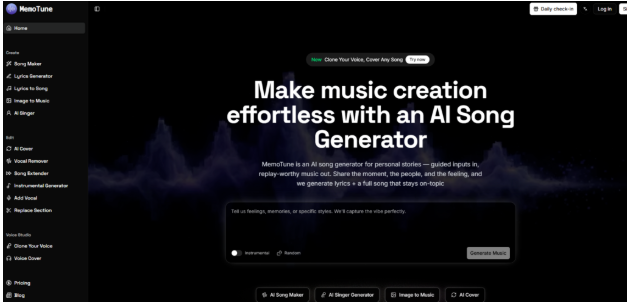
Most technology designed to capture memory focuses on the visual, photos, videos, time-lapses. But sound, especially a full song built around a specific moment, remains an underused medium for preservation. Not because people don’t want it, but because commissioning a custom piece of music has always required money, connections, and a long wait. The Ai Song Maker attempts to collapse that barrier by letting anyone describe a personal story and receive a complete, listenable track in return. I set out to test whether the output felt like an artifact worth keeping, or just a mechanical echo of the words I typed.
What a Song Can Hold That a Photo Cannot
A photograph freezes a visual instant, but a song can carry the emotional arc of an entire afternoon. The shift in mood from verse to chorus, the tension in a bridge, the release at the end, these structural elements map surprisingly well onto how we remember life events. The platform’s approach, guiding the user to describe people, events, and feelings rather than choose a genre or tempo, acknowledges that most of us store memories as narratives, not as music theory. This matters when the goal is a keepsake. A birthday gift for a parent should not sound like a generic pop template. It should carry the weight of inside jokes, the texture of a specific place, and the tone that only the sharer can articulate.
A Walk Through Creation With an Heirloom Mindset
I approached the entire workflow not as a production task, but as if I were commissioning a songwriter to capture something irreplaceable. The interface supported that mindset by never pushing me toward technical decisions before I had fully described the moment.
Step 1: Give the AI the Scene, Not Just a Summary
The first input stage asks for a memory, the people in it, and the feelings attached. I used a quiet morning from childhood, sitting on a porch with a grandparent, the smell of coffee and wet grass, the slow conversation that felt unimportant at the time but stayed with me for decades.
Why Emotional Specificity Outperformed Broad Description
Initially, I wrote a short, safe description: “a happy childhood memory with my grandfather.” The result was warm but forgettable, the lyrical equivalent of a greeting card. I then retold the story with precise sensory details, the creak of the wooden steps, the specific joke about birds stealing his hat, the mixed feeling of safety and the faint understanding that these mornings would not last forever. The regenerated song changed entirely. The verses referenced the creaking porch and the stolen hat, and the melody held a gentle melancholy beneath its warmth. From a practical user perspective, the platform rewarded emotional honesty and concrete detail far more than I expected.
Step 2: Trust the AI to Find the Musical Shape
After submitting the refined story, I let the system compose without any manual intervention. It produced lyrics, vocal melody, instrumentation, and a full arrangement in a single pass.
When the Arrangement Mirrors the Memory’s Own Rhythm
The output arrived as a complete audio file with synced lyrics. What struck me was the pacing. The quiet introduction felt like the slow start of that morning; the fuller instrumentation in the middle echoed the livelier conversation; the stripped-back ending mirrored the goodbye. I had not instructed any of this. The AI appeared to take emotional cues from my story’s arc and translate them into musical dynamics. The vocal delivery leaned into a soft, reflective tone, avoiding over-polished vibrato that would have broken the intimacy. In my testing, this was the moment the tool stopped feeling like a generator and started feeling like a preservation device.
Step 3: Polish the Artifact Without Breaking Its Soul
The platform offers editing controls that allow verse replacement, song extension, and stem separation. I used these to refine the keepsake without losing the core emotion that already worked.
Using Stem Separation to Adjust the Emotional Mix
I separated the vocal and instrumental stems and lowered the piano slightly to bring the vocal narrative forward. This small change made the song feel more like a whispered memory and less like a produced track. I also extended the outro by a few measures, giving the final line more room to breathe. The regenerate section feature let me replace a single line that felt too literal, and the new line fit seamlessly. The editing never required me to understand mixing terminology, just to listen and react. The final file, downloaded as a WAV, felt ready to share or archive.
Three Keepsake Scenarios and the Emotional Accuracy Tested
To understand the range of the output, I pushed the platform across different types of personal requests, each with its own emotional demands.
Test 1: Honoring a Lost Pet With Gentle Recall
The task was a memorial song for a dog that had been a family companion for fourteen years. The difficulty was balancing sadness with celebration, avoiding a funeral dirge. I described the dog’s habit of waiting by the door, the sound of paws on wood, and the specific joy of a sunlit walk.
The result avoided melodrama. The lyrics referenced the door and the walk without ever sounding forced. The melody was tender and uplifting in its chorus, exactly the tone I had hoped for. In my testing, the bridge introduced a shift to a more reflective minor feel before resolving, which gave the song emotional depth. The weakness was that a single line felt slightly generic, but using the replace feature fixed it quickly. For someone grieving, the process of describing the memory itself was cathartic, and the final song became a small, permanent monument.
Test 2: An Anniversary Song That Recreates a Shared Story
The task was to create a personal track for a wedding anniversary, rooted in the story of how the couple met at a bookstore. The challenge was avoiding cliché love song lyrics and instead embedding specific, true details.
I described the rainy evening, the book that fell, the conversation about a specific author, and the gradual realization. The output captured the bookstore setting in the first verse, even naming the author I mentioned. The melody had a folky, acoustic warmth that suited the story’s intimacy. It was not a radio hit, but it was undeniably theirs. This level of personalization, where private details become the lyrical spine, is where the Ai Song Maker separates itself from one-size-fits-all music generators. The ability to download and share it immediately meant the gift could be delivered the same day.
Test 3: A Lullaby Built From a Bedtime Ritual
I tasked the platform with creating a lullaby that reflected a father’s nightly routine with his daughter: a specific songbird they imitated, a phrase they repeated, and the feeling of safety in the dark. The challenge was softness without drifting into inaudibility.
The output surprised me with its simplicity. The vocal was quiet and close, the instrumental sparse, mostly soft guitar. The repeated phrase appeared as a refrain, anchoring the song in their private ritual. The tempo felt naturally sleep-inducing. For parents who want to gift a lasting sonic hug, the tool delivers something that feels hand-stitched rather than mass-produced.
A Comparison of Memory-to-Music Approaches
The table below contrasts the method of crafting personalized keepsakes with the platform against other common ways people attempt to turn memories into songs.
| Aspect | Commissioning a Human Songwriter | DIY Recording with Basic Tools | Memotune’s Narrative-Driven Workflow |
| Time from Idea to Finished Song | Weeks to months, depending on availability. | Days to weeks for non-musicians to learn and record. | Minutes to hours, depending on editing depth. |
| Cost Barrier | High; professional rates per song. | Variable; equipment and software costs. | Low monthly subscription; no per-song fee. |
| Personal Detail Incorporation | High, but requires clear communication. | Limited by user’s musical and lyrical skill. | High when the story description is vivid and specific. |
| Editing Flexibility | Depends on the songwriter’s revision policy. | Full control, but requires technical ability. | Verse-level replacement, stem separation, and extension without technical skill. |
| Emotional Authenticity | Can be deeply personal. | Often frustrated by skill gaps. | Strong when the input story holds genuine emotional weight. |
| Privacy of the Story | Shared with another person. | Private, but files may be stored locally. | Platform states it does not use user content for model training. |
The Boundaries of an AI-Made Keepsake
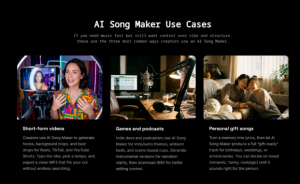
My testing revealed limitations that matter for this use case. The generation depends so heavily on the quality of the story input that a rushed or vague description yields a song that feels hollow, no matter how many times I regenerated. The vocal delivery, while pleasant and consistent, cannot yet replicate the specific timbre of a loved one’s voice; the announced custom voice models were not available during my tests. Songs intended to convey multiple conflicting emotions simultaneously, like joy mixed with regret and gratitude, sometimes flattened into a dominant single mood, requiring more editing to restore complexity. The platform does not offer instrumental customization at the track level during initial generation, so if a story calls for a specific instrument, I could not request it directly, though the general mood setting often supplied a fitting palette. The result may vary, and I found that subtle, quiet memories with rich sensory detail consistently outperformed big, loud, but vague events.
For Whom a Sonic Time Capsule Makes the Most Sense
The platform suits people who want to transform a specific, emotionally textured memory into a song they can keep or gift, without a budget, a deadline, or any musical training. It rewards those willing to describe not just what happened, but how it sounded, smelled, and felt in the body. For memorials, anniversaries, childhood keepsakes, and personal rituals, the output can become a genuine artifact. Those seeking a professional-grade vocal performance with full production control may find the tool a starting point rather than a final product. But if the goal is to hold a moment in melody and lyric, to create something that, when played years later, returns the listener directly to a morning on a porch or a dog’s paws on wood, the technology delivers something rare: a storage medium for the emotional truth that photographs alone cannot carry.
