

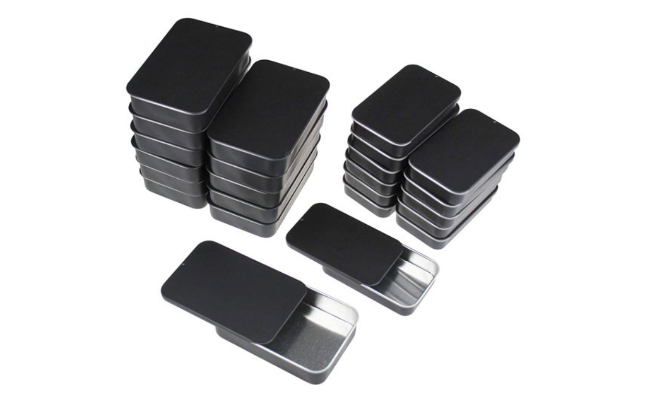
Black tins are a versatile packaging solution often used in various industries, such as food, cosmetics, and gifts. The manufacturing process of black tins involves many technologies to ensure the product is high-quality, durable, and beautiful. In this blog post, we will share the different manufacturing techniques of black tins to understand their processes, advantages, and applications.
1. Metal sheet cutting and forming
Making a black tin first involves cutting and shaping sheet metal. Operators feed sheet metal into a cutting machine, where precise measurements are programmed to trim the metal into appropriately sized blanks. Using a focused beam when cutting metal ensures clean edges and minimizes material waste. After cutting, the operator sends the blank to a forming station where various forming processes are performed to obtain the desired can shape. These processes include deep drawing or stamping. We emphasize maintaining dimensional accuracy, surface finish, and structural integrity throughout molding.
2. Surface treatment and coating of black tins
After molding, we thoroughly clean the surface of the can to remove any contaminants or residue that may compromise the coating’s adhesion. We use various methods depending on the substrate material and the type of contamination present, such as chemical cleaning, mechanical abrasion, or solvent degreasing. After cleaning, we pretreat the tanks to enhance coating adhesion and corrosion resistance. The applied conversion coating chemically modifies the metal surface to promote adhesion to subsequent coatings. Once complete, coatings for black cans may consist of multiple layers. Standard coating methods include spraying, powder coating, or electrodeposition, each with unique advantages.
3. Embossing of black tins
Once we prepare the surface of the black tin, we feed it into an embossing machine equipped with precision punches. As the black tins pass through the embossing machine, they are subjected to controlled mechanical pressure that forces the metal to conform to the shape of the embossing die. In this process, we must carefully calibrate pressure, temperature, and speed to achieve consistent results in high-volume production. Modern embossing machines often have automatic control and monitoring systems that allow precise execution and reduce variations from can to can.
4. Welding and assembly
In the final manufacturing stage, we use welding technology to connect the various parts of the black tank into a whole. Different welding techniques depend on material type, thickness, and design specifications. Standard methods include resistance, TIG, MIG, and laser welding. After successfully welding, we inspect the assembled parts to detect imperfections that could compromise the tank’s integrity. We use non-destructive testing methods such as visual inspection, color penetrant testing, or X-ray inspection to identify welding discontinuities such as cracks, voids, or incomplete fusion. Once the welding process is complete, the black tins undergo final assembly.
5. Quality control and inspection
Quality control is performed after the entire assembly is completed, starting with inspecting raw materials, including sheet metal, coatings, and components, to ensure they comply with composition, thickness, and surface finish. Visual inspections are also performed to detect surface defects or irregularities in the appearance of the can. Functional testing would ideally be conducted to evaluate the performance of the black tank under various conditions. This may include testing for leak resistance, pressure resistance, and other functional properties relevant to the intended use.
Make sure you have high-quality black tins!
Black tins are made using a combination of modern technology and traditional craftsmanship. The quality of the black tins is determined by every step of the manufacturing process. Therefore, we need to know some basic manufacturing information to judge their quality more easily during purchase.
