

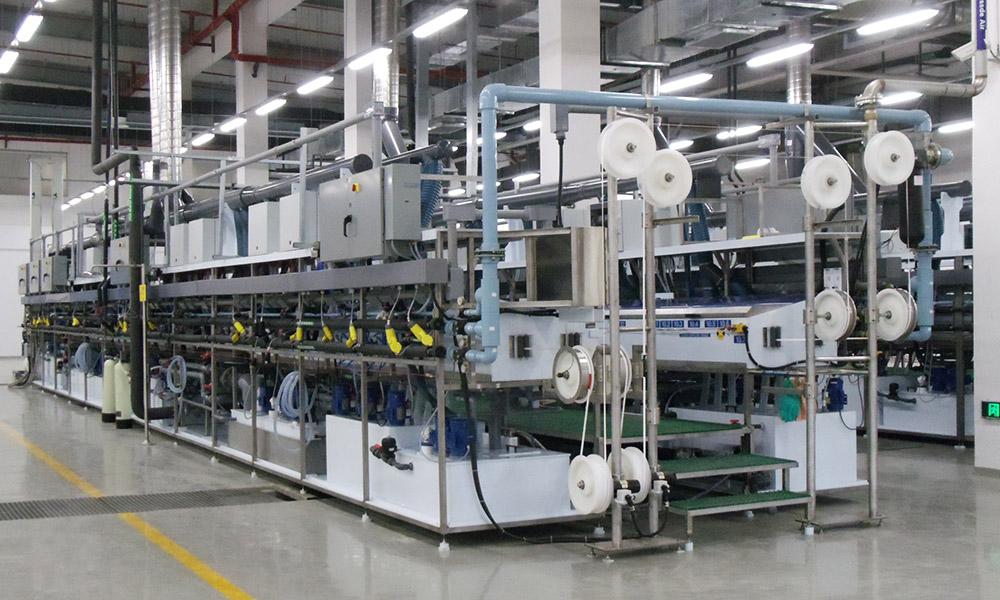
As electronic devices become smaller, faster, and more complex, the demand for precisely plated metal components continues to grow. Continuous reel-to-reel plating has emerged as the preferred method for finishing stamped and formed parts at scale, delivering the consistency and efficiency that high-volume production requires. At Leading Technologies, this process forms the foundation of a manufacturing operation built specifically for the interconnect industry.
What Is Continuous Reel-to-Reel Plating?
Continuous reel-to-reel plating is an electroplating process in which stamped or pre-formed components remain attached to a continuous metal strip as they pass through the plating line. The strip unwinds from one reel, travels through each stage of the process, and winds onto another reel once finished. Throughout this journey, the parts never leave the strip.
This continuous format is what gives the process its name and its advantages. Stamped and continuous parts are typically produced in strip form before singulation, which is why continuous reel-to-reel plating is the natural choice. If these parts were removed from strip form for batch plating, it would introduce variability, misalignment, and potential damage. Keeping them on the reel preserves alignment and protects part integrity.
Why Continuous Reel-to-Reel Plating Outperforms Batch Methods
The biggest advantage of continuous reel-to-reel plating is consistency. Because components stay indexed on the strip, every part passes through the line under identical conditions. This produces uniform plating thickness and coverage that loose-piece batch plating cannot reliably match.
The process also protects delicate parts. Fine contacts, terminals, and leadframes are easily bent or contaminated when handled individually. By keeping them on the carrier strip, reel-to-reel electroplating minimizes handling and the defects that come with it. The continuous flow additionally supports high throughput, making it well suited to the large quantities modern electronics demand.
How the Reel-to-Reel Electroplating Process Works
Understanding the value of the process starts with understanding its controlled, sequential nature.
Strip Feed and Surface Preparation
The process begins with a continuous strip of metal that already contains stamped components. These parts remain attached to the strip throughout, allowing them to move smoothly through each stage. Surface preparation cleans the material so plating adheres correctly and performs reliably in the field.
Selective and Controlled Plating
As the strip advances, components move through plating stations where metals are deposited with tight control. Reel-to-reel electroplating often applies finishes selectively, placing precious metals only on functional contact areas to conserve material while meeting performance requirements. Common finishes include gold, nickel, silver, palladium, and specialty alloys.
Finishing, Inspection, and Singulation
After plating, parts may receive secondary finishing and undergo inline inspection to verify quality. When required, the components are then singulated, or separated from the strip, ready for assembly. Keeping inspection inline ensures defects are caught before parts advance.
About Leading Technologies
Founded in 1993, Leading Technologies continues to build on decades of continuous reel-to-reel plating expertise for stamped and formed components. As part of the Composidie family, with roots tracing back to 1971, the company draws on an established heritage of precision manufacturing and process innovation. Operating from Vandergrift, Pennsylvania, it specializes in the plating of stamped contacts, leadframes, and other formed metal parts.
Leading Technologies serves automotive, semiconductor, aerospace, and defense customers, all of whom depend on reliable, repeatable results. The company holds IATF 16949 certification and pairs its plating expertise with secondary finishing, strip cutting, singulation, and leadframe and heatsink assembly. Customers can supply their own materials or rely on turnkey solutions managed under one roof.
Industries That Depend on Reel-to-Reel Plating
A broad range of industries rely on continuous reel-to-reel plating to produce dependable interconnect components at volume. The sectors that benefit most include:
- Automotive electronics requiring durable, high-reliability connectors
- Semiconductor packaging built around precisely plated leadframes
- Aerospace and defense systems with strict performance standards
- Telecommunications equipment demanding consistent signal integrity
- Consumer electronics produced in extremely high quantities
In each application, the combination of consistency, protection, and throughput makes reel-to-reel processing the clear choice for finishing interconnect components.
The Value of an Integrated Plating Partner
The full benefit of continuous reel-to-reel plating emerges when it is part of an integrated manufacturing operation. Leading Technologies offers not only plating but the surrounding processes that turn a plated strip into a finished, ready-to-assemble component. This consolidation reduces the handoffs between vendors that so often introduce defects.
That advantage is amplified by the Composidie family connection, which links plating with die design, stamping, and assembly capabilities. When stamping and reel-to-reel electroplating are coordinated as a single workflow, alignment stays tight, lead times shrink, and quality improves. For engineers sourcing plated interconnect components, a single integrated partner means fewer risks and a faster path to production.
Finishing the Future of Electronics
Continuous reel-to-reel plating is the backbone of modern interconnect manufacturing. By keeping parts on the strip from feed to finish, it delivers the consistency, protection, and efficiency that high-volume electronics demand. Through precise reel-to-reel electroplating, integrated finishing, and decades of expertise, Leading Technologies ensures that interconnect components meet the exacting standards of the industries they serve. As devices grow smaller and more complex, continuous reel-to-reel plating will remain a critical technology in bringing them to life.
